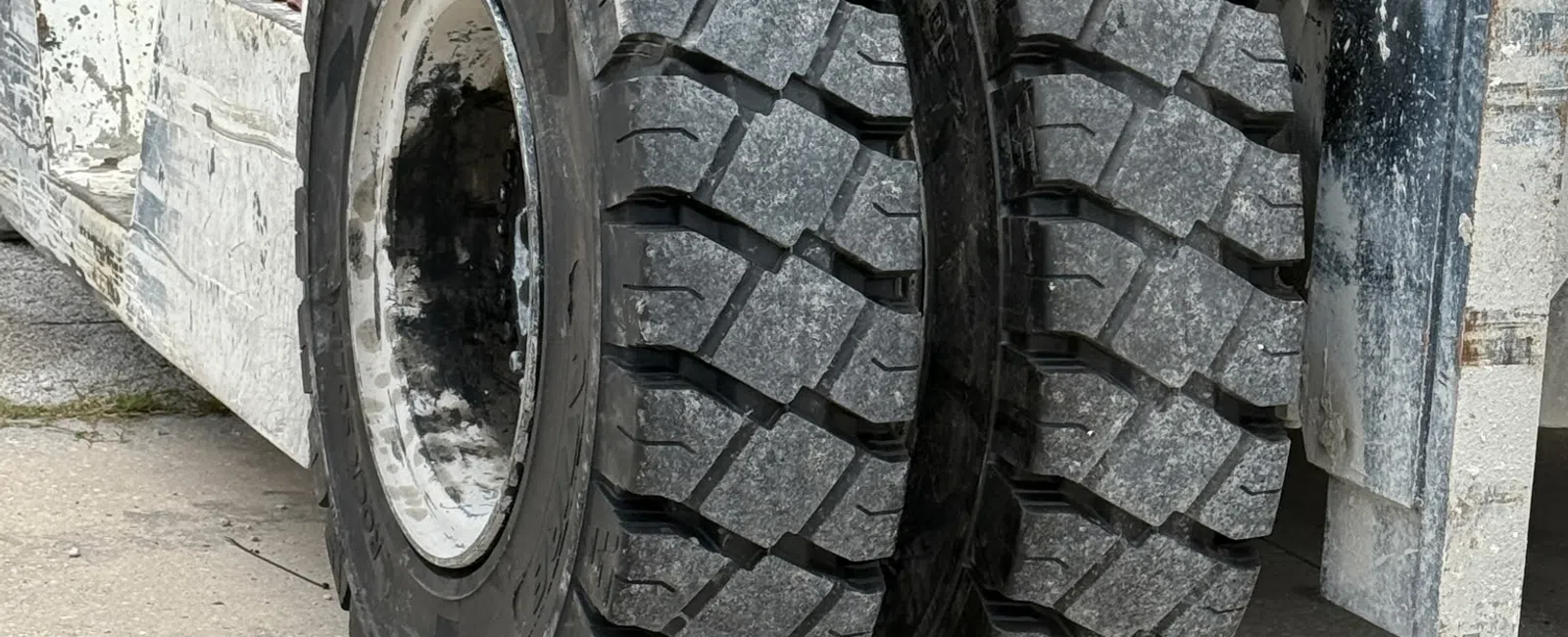
Solid pneumatic tires look like a standard air-filled tire but contain no air at all. The tread pattern and sidewall shape mimic a pneumatic tire, but the body is molded from solid rubber. For fleets running forklifts and rough-terrain equipment outdoors, that difference changes how the equipment handles ground conditions and how much downtime a flat can cause.
What makes a solid pneumatic tire different
A pneumatic tire relies on air pressure to absorb shock and hold its shape. A solid pneumatic tire relies entirely on the rubber compound itself. That means no air pressure to check, no risk of a puncture flat, and a tire that keeps its tread pattern and footprint even on gravel, packed dirt, or debris-covered lots.
The tradeoff is ride quality. Without an air cushion, a solid pneumatic tire transmits more of the ground's texture into the equipment than an air-filled tire does. On smooth pavement that difference is minor. On rough or uneven ground, operators notice a firmer ride. Most fleets running outdoor equipment accept that tradeoff in exchange for never dealing with a flat mid-shift.
It's also worth separating solid pneumatic tires from cushion and press-on tires, since the names get used loosely on job sites. Cushion and press-on tires are built for smooth indoor floors and mount directly onto a steel wheel band, with no tread pattern designed for traction on loose or uneven surfaces. Solid pneumatic tires are built for the same outdoor conditions a standard pneumatic tire handles: gravel, dirt, mud, and debris, just without the air.
When solid pneumatic tires make sense
- Outdoor forklifts working on uneven ground. Yards, lumber lots, and construction sites with gravel or debris are where puncture flats happen most often. A solid pneumatic tire removes that risk entirely, since there's no air chamber for debris to puncture.
- Rough-terrain equipment that can't afford downtime. Telehandlers and rough-terrain forklifts working an active job site don't have the luxury of waiting for a mobile technician while an air-filled tire sits flat. Solid pneumatic tires keep the equipment moving.
- Sites with sharp debris underfoot. Scrap yards, demolition sites, and lots with metal shavings, nails, or broken concrete are common environments where standard pneumatic tires wear out fast from repeated punctures and patches.
Outside of those conditions, a standard pneumatic tire is often still the better choice. Solid pneumatic tires cost more upfront and ride firmer, so they make the most sense where puncture risk and downtime are the bigger problem to solve.
Knowing when a solid pneumatic tire needs replacing
Solid and resilient tires use the wear line molded into the tread, often labeled 60J, as the replacement trigger. Once tread wears down to that line, the tire no longer has enough rubber to protect the equipment or maintain traction on loose surfaces, and it should be replaced. This is different from press-on tires, which come out around two-thirds of their original rubber height rather than a molded wear line, so it's worth knowing which type is on your equipment before judging remaining tread life.
Watching that wear line matters for more than traction. A solid tire worn past its indicator transmits more shock into the equipment's axle, mast, and hub bearings, which can accelerate wear on components that cost far more to repair than the tire itself. Checking tread depth during routine equipment inspections catches this before it turns into a bigger repair.
Uneven wear is also worth flagging early. A solid pneumatic tire wearing faster on one side often points to an alignment issue or a tire that was mismatched to the surface it's running on, rather than a problem with the tire itself.
Compound choice: standard rubber vs. non-marking
Solid pneumatic tires come in more than one rubber compound, and the right one depends on where the equipment runs. Standard black rubber is the default choice for most outdoor and job site work. It holds up well against abrasion from gravel, dirt, and debris, and it's the more common option for yards, lumber lots, and construction sites.
Non-marking rubber is a different compound designed to avoid leaving black scuff marks on indoor or finished floor surfaces. It matters less when equipment stays outdoors on dirt or gravel, but it becomes relevant the moment that same equipment crosses into a warehouse, a paved lot with painted lines, or any space where floor appearance is part of the job. Some fleets run mixed routes, moving equipment between a rough outdoor yard and a finished indoor floor in the same shift, and end up needing non-marking tires even though the equipment spends most of its time outside.
Choosing the wrong compound doesn't just affect appearance. Non-marking compounds are formulated differently than standard black rubber, so matching compound to the surface the equipment actually runs on protects both the floor and the tire's expected wear life.
Getting solid pneumatic tires installed
Because solid pneumatic tires are a single molded unit rather than an inflatable one, removing and seating a new tire requires a hydraulic press. That's not a job most shops can do in the field with hand tools, and it's why fleets running outdoor equipment often schedule this work in advance rather than wait for a tire to fail and pull the machine out of rotation.
GAIT brings the press to the equipment instead of the other way around. Our mobile trucks are equipped to install solid pneumatic tires on-site, whether that's a single forklift or a full yard of rough-terrain equipment, so the machine goes back to work without a trip to a shop. For fleets running multiple pieces of equipment across a job site or yard, that on-site capability is often the difference between a planned service stop and an unplanned one.
If you're running forklifts or rough-terrain equipment outdoors and dealing with recurring flats, call 770.446.6467 to talk through whether solid pneumatic tires are the right fit for your fleet.