Scissor lifts and boom lifts raise people instead of pallets, and that changes what the tires have to do. Load matters less than stability. The tire under an aerial work platform is part of the machine's balance, which is why the options are narrower than they are on a forklift and why swapping tire types is not a casual decision.
Slab Scissor Lifts Run Solid Non-Marking Tires
Most electric scissor lifts, the 19-foot to 32-foot machines working inside warehouses, retail buildouts, and finished commercial space, ride on small solid tires. Common sizes land around 12x4.5, 15x5, and 16x5, often pressed or bolted to the wheel as a single assembly.
Nearly all of them come non-marking compound from the factory, and for good reason. These machines spend their lives on sealed concrete, epoxy, and polished floors where a black streak is a cleanup bill. Non-marking compound is lighter in color and formulated without the carbon black that leaves scuffs.
The trade-off is wear. Non-marking solid tires are harder and wear faster on rough or abrasive surfaces, and they offer less grip on wet or dusty concrete. A slab scissor lift that gets dragged across a gravel lot between jobs will chew through its tires well ahead of schedule.
Three things shorten the life of a slab scissor tire more than anything else:
- Driving across thresholds, expansion joints, and dock plates at speed
- Turning in place on abrasive concrete, which scrubs the outer edge
- Storing the machine outdoors on a tire that was never built for it
Rough-Terrain Scissors and Booms Run Foam-Filled or Solid
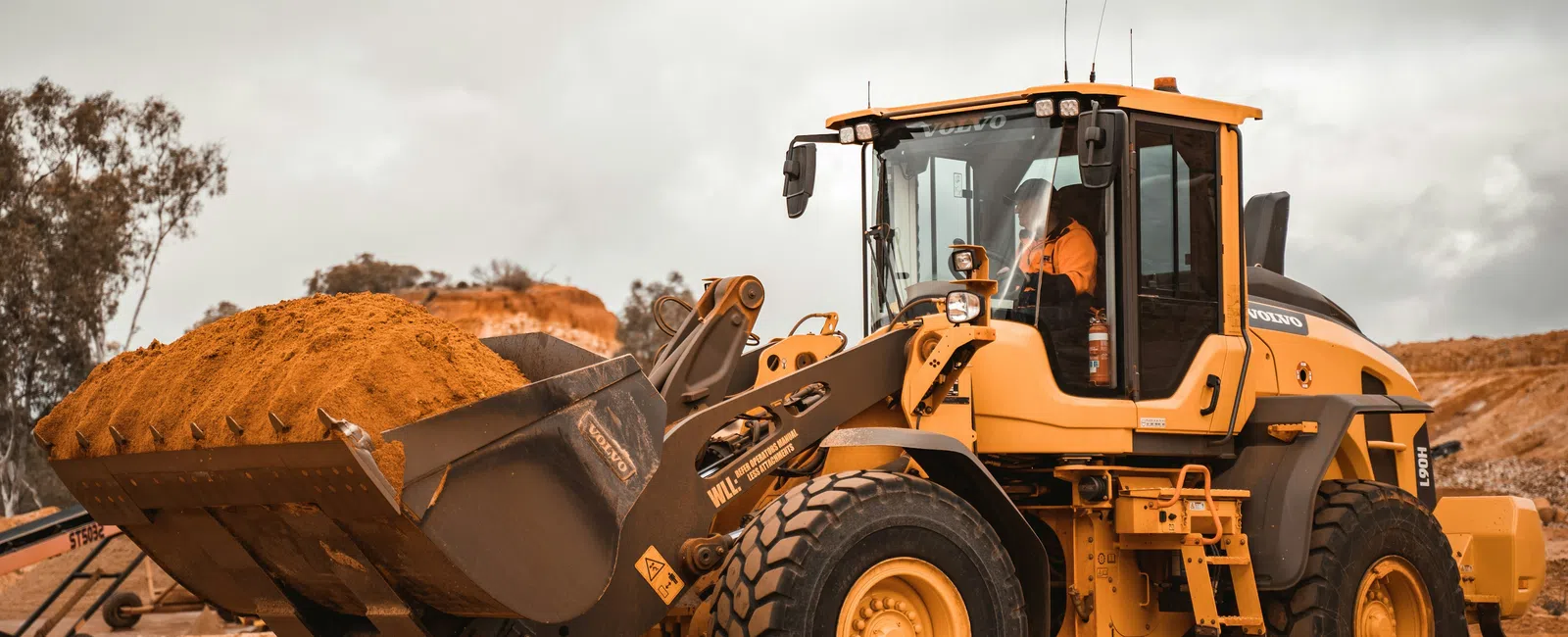
Once a lift leaves the slab, the tire changes completely. Rough-terrain scissor lifts and nearly every articulating or telescopic boom lift run a lug-tread tire sized like a small loader tire: 12-16.5, 15-19.5, 385/65D22.5, and up to 445/65D22.5 on the big telescopic booms.
Most of these ship from the factory foam-filled tires, and a lot of operators never think about why. A boom lift at full extension is a long lever on a small footprint. A pneumatic tire that loses pressure on one side tilts the chassis, and at 60 or 80 feet of reach that tilt shows up at the platform as a serious stability problem. Filling the tire with polyurethane foam removes the air so a puncture, a sidewall cut, or a slow leak cannot change the geometry of the machine.
The foam also adds weight, and that weight is counted. Manufacturers factor the mass of foam-filled tires into the machine's counterweight and stability calculations. Replacing a foam-filled tire with an air-filled one of the same size can put the lift outside its certified stability envelope. The reverse is also true: a lift that was built around pneumatic tires may not be rated for the added weight of foam. When in doubt, the machine's data plate and the manufacturer's tire specification settle it.
Solid tires are the other common option on booms and rough-terrain scissors. They are heavier than foam-filled, ride harder, and cost more up front, but they cannot be cut and have no fill to degrade. Rental fleets running machines across demolition sites, rebar yards, and recycling facilities often spec them for that reason.
When Aerial Lift Tires Need Replacing
Solid and foam-filled lift tires do not go flat, so the usual warning signs do not apply. The signs to watch for instead are chunking and cracking in the tread, visible separation where the rubber meets the wheel, and a tire that has worn through its lug pattern down to the base. On foam-filled tires, bulging or a soft spot can mean the fill has broken down inside the casing.
Uneven wear across a set deserves attention too. If one tire on a boom is visibly shorter than the other three, the machine is sitting out of level before the operator ever raises the platform.
Replace in matched sets, or at minimum in matched pairs on the same axle. Mixing a new foam-filled tire with three worn ones changes the ride height from corner to corner.
Why Installation Is the Part Most Fleets Get Wrong
Foam-filled tires are not something a shop mounts and sends out the same day. The fill has to cure, and cure time runs into days before the tire is ready to carry a lift. That is why a down boom waiting on foam-filled replacements can sit for most of a week.
The way around it is an assembly exchange. Pre-filled tire and wheel assemblies, already cured and ready to bolt on, go onto the machine on site, and the worn assemblies come off to be refilled. The lift goes back to work the same visit. Georgia Industrial Tire runs this program out of Doraville across metro Atlanta and North Georgia, with mobile trucks that bring the press, the assemblies, and the technician to the job site or rental yard.
For solid scissor lift tires, the same mobile approach applies. A tech with a portable press replaces a set of pressed-on scissor tires on site, without the machine ever leaving the building.
Worn tires leave on the same truck. Disposal runs through Georgia EPD-compliant channels, so the fleet manager is not left with a pile of foam-filled casings behind the shop.
Match the Tire to the Machine, Not the Lot It Sits On
The temptation with a mixed fleet is to standardize on one tire type for everything. It does not work on aerial lifts. A slab scissor needs non-marking solids. A rough-terrain boom needs the foam-filled or solid tire the manufacturer built the stability calculation around. Changing either one to save on the purchase changes how the machine behaves at height.
If a scissor lift or boom lift in the fleet is riding on chunked, cracked, or mismatched tires, or if a down machine is waiting on a foam fill, call Georgia Industrial Tire at 770.446.6467. Mobile installation and pre-cured assembly exchange are available across metro Atlanta and North Georgia, and the technician comes to the machine.