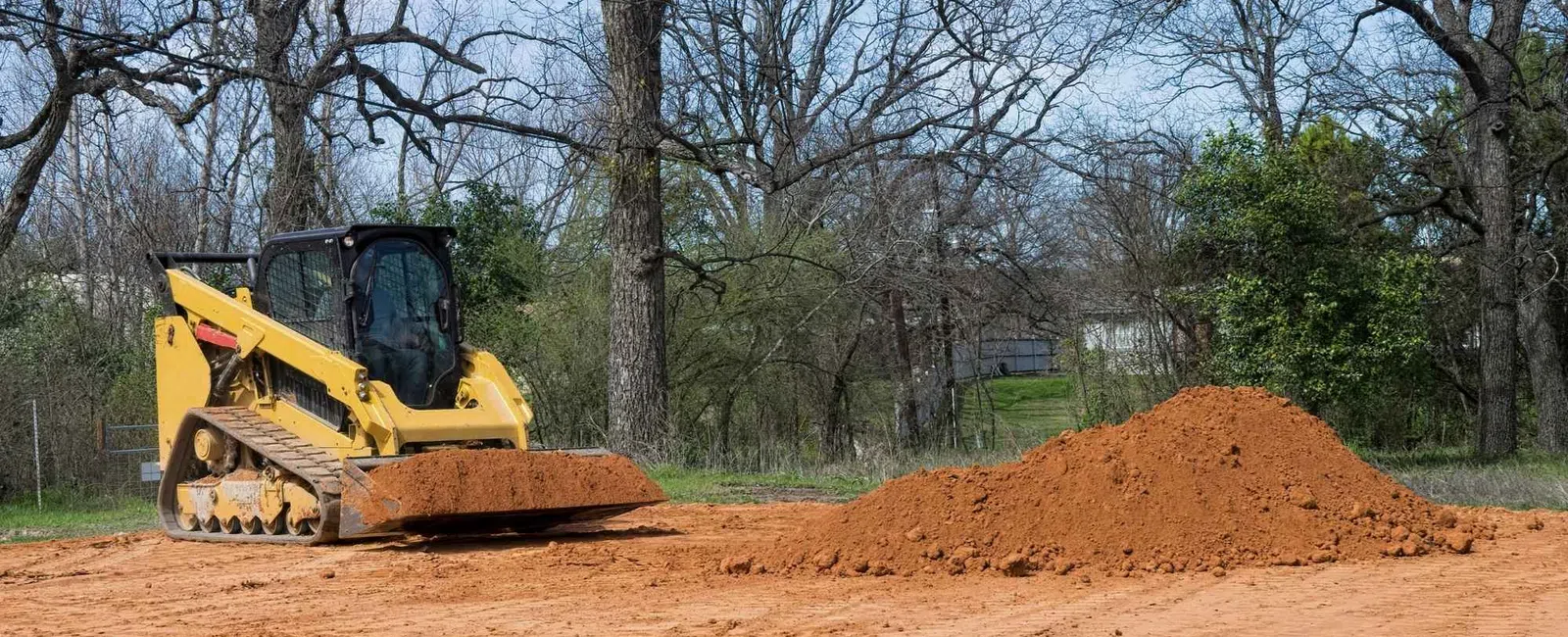
A compact track loader spreads the machine's weight across two long rubber footprints while a skid steer puts the same weight on four small tire contact patches, and that single difference drives most of the track loader vs skid steer decision. Ground pressure, traction, operating speed, surface damage, and what wears out underneath all follow from it. We supply and install both skid steer tires and rubber tracks across Georgia, so the comparison below comes from what we see on the machines, not from a sales floor.
Ground Pressure and Flotation
Rubber tracks carry the load over a footprint many times larger than a tire's contact patch, so the machine sinks less, rides over soft spots, and leaves lighter ruts. On saturated Georgia red clay after a week of rain, that flotation is the difference between a machine that keeps working and one that digs itself in. The same property matters on finished lawns, sports fields, and landscaping jobs, where a stagger block track pattern spreads the load even wider.
A skid steer concentrates the load, which is a disadvantage in mud and an advantage on hard ground. On compacted gravel, concrete, and asphalt, the smaller contact patch gives the machine a lighter, quicker feel, and it does not scuff the surface the way counter-rotating tracks do. Soft ground and agricultural work favor pneumatic skid steer tires because the air chamber adds some flotation, but no tire matches a track on wet ground.
Traction and Pushing Power
Tracks hold grade and push harder on loose material because more rubber is on the ground at any moment. Grading slopes, pushing fill, and clearing lots with loose topsoil are track loader work. The multi-bar and straight bar track patterns exist for exactly this: deep lugs that bite in soft ground and self-clean in mud and sand.
A skid steer loses traction first on loose or wet surfaces, where the tires spin and the machine sits. On hard surfaces the comparison flips. Non-directional skid steer tires on concrete and asphalt grip well, last longer than directional patterns, and let the machine spin in place without the lug shearing that counter-rotation causes on a track.
Speed and Hard-Surface Work
Skid steers travel faster, turn tighter, and move between work areas with less wear. Demolition cleanup, scrap handling, recycling yards, warehouses, and paved sites are skid steer territory. The machine spins on its own footprint, loads a truck, and moves on, and a smooth or non-directional tire takes that abuse for hundreds of hours.
Running a track loader on concrete and rebar is the fastest way to wear out a set of tracks. Counter-rotating on abrasive surfaces is the hardest thing an operator can do to a track, and machines working concrete wear tracks far faster than machines on dirt. Operators who must run tracks on hard ground extend track life with three-point turns instead of spot turns. If the machine spends most of its hours on pavement, the skid steer tires we stock in the common 10x16.5, 12x16.5, and 14x17.5 sizes are the lower-wear choice.
What Wears Out Underneath
Tracks and tires wear differently, and the undercarriage is where a track loader spends its maintenance hours.
- Rubber tracks commonly last 1,200 to 1,600 hours, but surface abrasiveness, turning habits, tension, and undercarriage condition move that number more than brand does.
- A track loader also wears sprockets, idlers, and rollers, and a worn undercarriage is the most common cause of early track failure; a new track on a worn undercarriage tends to fail early.
- Pneumatic skid steer tires commonly run 600 to 1,200 hours on mixed ground, and solid skid steer tires commonly run several times that, with no sprockets or rollers behind them.
Track tension has to match the manufacturer's specification rather than feel. Too loose and the track can derail and shear lugs; too tight and the sprockets, idlers, and the track itself wear early. A skid steer has no tension to manage, but skid-steering scrubs the tires on every turn, and surface hardness affects tire wear more than load does. Our rubber tracks are sized by width, pitch, and link count, such as 320 x 86 x 49, and all three numbers must match the machine or the track will not tension correctly.
Flats, Punctures, and Downtime
A skid steer on pneumatic tires stops when it punctures, and demolition, scrap, and recycling sites produce sidewall damage constantly. Solid tires remove the flat entirely, and foam-filled tires keep the original tread and a ride closer to air while removing the flat. On mixed construction ground, foam-filled is the usual compromise; on demolition and scrap, solid.
Tracks do not go flat, but they fail in their own way. Lugs worn to roughly half their original height, rounded drive lugs, cracks deep enough to reach the steel cords, or any visible cord mean the track comes off. Exposed cords call for immediate replacement, because a track that lets go on a slope is a machine that stops moving.
Where Each Machine Belongs on Georgia Jobsites
Three conditions settle most of the track loader vs skid steer calls we see.
- Soft, wet, or sloped ground, lawns, and loose fill point to a track loader with a C-lug pattern for general work or a multi-bar pattern for mud.
- Concrete, asphalt, compacted gravel, demolition, scrap, and recycling point to a skid steer on non-directional or smooth tires, solid where sidewall damage is constant.
- Mixed sites that move between dirt and pavement run either machine, and the right tire or track is chosen for where the machine spends most of its hours, not the worst surface it occasionally crosses.
Many Georgia contractors run both, and the question becomes which machine goes to which site rather than which machine to own. On that split, the consumable underneath decides: a track loader on a paved site burns tracks, and a skid steer on wet clay sits.
Keeping Either Machine Running
The tracks and tires on both machines are what we supply and fit on-site. A fleet tire assessment checks tooth wear, roller condition, and running tension on track loaders alongside tread depth and sidewall condition on skid steers, so the replacement happens on the schedule instead of on the jobsite. Rubber track installation and skid steer tire changes both happen at the yard or jobsite in most cases, with the old tracks and tires hauled off and disposed of under Georgia EPD regulations.
Send us the machine make and model, the track size molded into the inside face or the tire size on the sidewall, and the surface it works most of its hours on. Georgia Industrial Tire has fitted tires and tracks on-site across metro Atlanta and North Georgia since 1993. Call 770.446.6467 or use the need tires now form for a quote per machine.