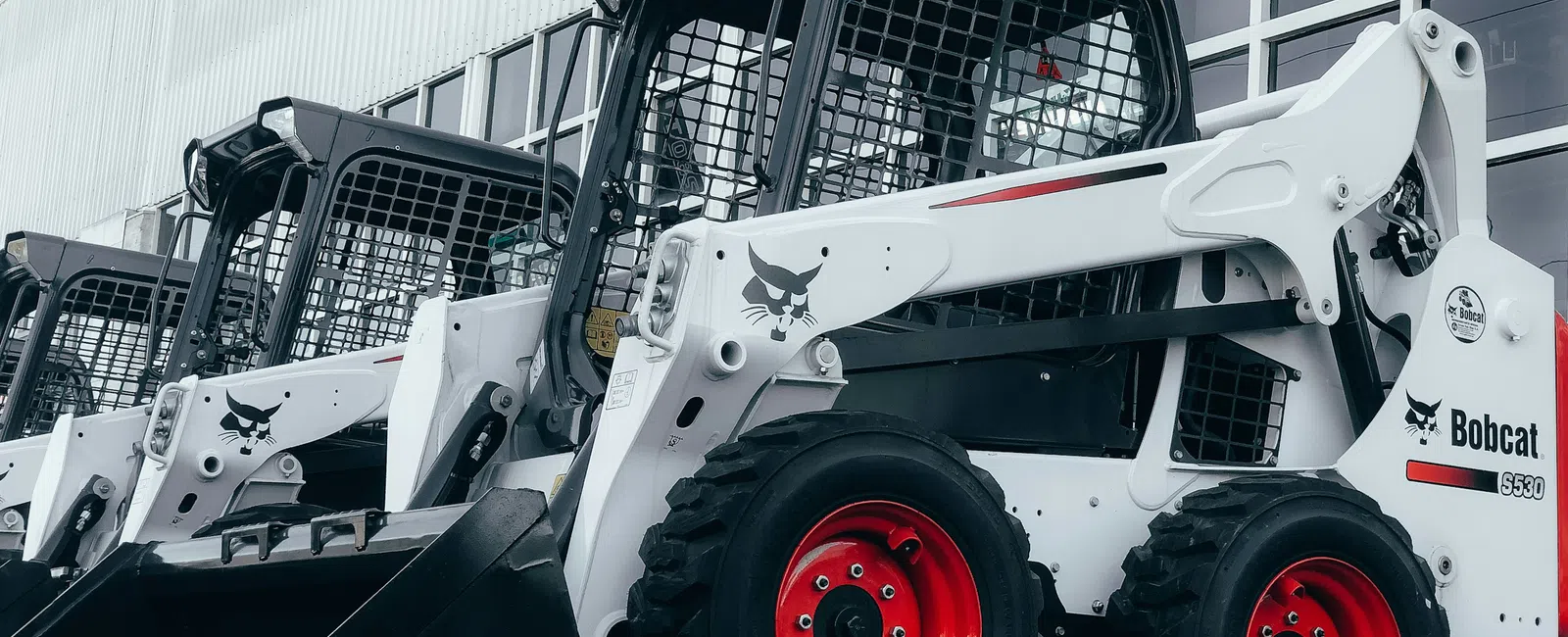
Skid steer tire sizes look like they should be simple, and mostly they are, but the format does not work the way a car tire size does. If you are staring at a sidewall trying to figure out what your machine takes, here is what the numbers mean and what they leave out.
The two numbers that matter
A skid steer size reads as something like 12-16.5. There are only two figures in it.
- 12 is the section width of the tire in inches, measured at the widest point of the sidewall on a mounted, inflated tire.
- 16.5 is the diameter of the rim it mounts on, also in inches.
You will see the same size written as 12x16.5 or 12 16.5 depending on who is writing it. Those are the same tire. The dash and the x are interchangeable in this particular format, which is not true of every tire size convention, but it holds here.
What is missing compared to a passenger car size is the aspect ratio. A car tire gives you sidewall height as a percentage of width. A skid steer size does not, because these tires are built to a standard profile for the size. That is convenient when you are ordering, and it is also why two tires with the same printed size can still have slightly different overall diameters depending on construction and manufacturer.
Which machines run which size
Smaller and mid-size skid steers most often run 10-16.5. Larger machines step up to 12-16.5, and the biggest wheeled units go to 14-17.5. Compact and mini loaders run their own smaller sizes that do not follow this pattern at all.
The rim diameter is the hard constraint. A 10-16.5 and a 12-16.5 both mount on a 16.5 inch rim, which leads people to assume the two are interchangeable. They are not, at least not without checking the machine. The wider tire needs a wheel rated for that width, and it needs enough clearance in the wheel well and the loader arms to turn under full lock without contact. Going wider also changes the machine's footprint and ground pressure, which is sometimes exactly what an operator wants and sometimes the reason a machine starts rubbing.
Going narrower has its own consequences. Less contact patch on the same weight means more ground pressure, faster wear, and less flotation on soft ground.
Ply rating is a separate spec
After the size you will often see something like 10PR, 12PR, or 14PR. That is the ply rating. It indicates load capacity and puncture resistance rather than a literal count of fabric layers, which is a holdover from when it did mean exactly that. A higher ply rating on the same size gives you a stiffer casing, more resistance to sidewall damage, and more carcass to get through before something reaches the air inside.
Ply rating is where a lot of premature failures actually start. A machine handling heavy material over broken concrete or demolition debris on a light-rated tire will chunk, cut, and fail early even though the size on the sidewall is correct. The tire was never wrong for the machine. It was wrong for the work.
The trade-off is ride and traction. A stiffer, higher-rated tire is less forgiving on the operator and conforms less to uneven ground. On a machine that spends its life on dirt and turf, that stiffness buys you nothing.
Bias and radial in the same sizes
Most skid steer tires are bias ply. The plies run at an angle across the tire, which makes for a stiff sidewall that resists cuts and handles the side loading a skid steer puts into a tire every time it turns. That side loading is significant. A skid steer steers by dragging tires sideways across the ground, so the sidewall takes abuse that a conventional steered machine never puts into a tire.
Radials exist in the common sizes. The plies run perpendicular to the direction of travel, which lets the tread and the sidewall flex independently. That means a larger contact patch under load, cooler running on long duty cycles, and usually longer tread life. The sidewall is more vulnerable to cuts, though, and the initial investment is higher.
Neither is universally better. Bias tends to make more sense on machines working sharp, cut-heavy environments. Radial tends to make more sense on machines running long hours on relatively clean surfaces where heat and wear are the limiting factors.
Why mixing sizes causes damage
This is the part that catches fleets, and it is worth understanding before you replace one corner.
A skid steer drives all four wheels at the same rate on each side. There is no differential letting one wheel turn slower than another. If one tire on a side has a meaningfully different rolling circumference than the other, whether from a different size, a different construction, or just a lot more wear, the two are forced to turn at the same speed while wanting to travel different distances. The difference gets absorbed as scrub against the ground and as load into the chain drive.
The result is accelerated wear on the mismatched tire and strain on the drivetrain. On a machine that is already high hours, that is not a cheap thing to find out about later.
The working rule is to replace in pairs on the same side at minimum, and to replace all four when the wear across the machine is uneven enough that a single new tire would be noticeably taller than the rest. Matching construction across the machine matters for the same reason.
Three things the size does not tell you
- Air-filled, foam-filled, and solid tires all use the same size designations. A 12-16.5 solid and a 12-16.5 pneumatic are the same fitment and completely different tires in weight, ride, and how they fail.
- Tread pattern. Industrial, hard surface, turf, and snow patterns are all available in the common sizes. The size tells you what fits, not what belongs on the surface you run.
- Wheel condition. The correct size still fails early on a wheel that is bent, corroded, or out of round, and a wheel problem is easy to miss when the tire covers most of it.
When the sidewall is gone
Worn smooth, packed with mud, or curbed off entirely is normal on a skid steer, and a tire that has been run hard often loses its markings before anyone thinks to write the size down. The size is usually stamped on the wheel as well, and it is listed in the machine documentation.
Our techs can pull it directly off the equipment on site, including wheel width and condition, so nobody is guessing from a photo or a size somebody wrote on a clipboard three years ago. On a mixed fleet, getting every unit documented in one pass means the next replacement starts with a known size instead of a phone call and a tape measure.
Send us the make and model of the machine and we will confirm the size, the ply rating, and whether the construction you are running now is right for the surface it works.