
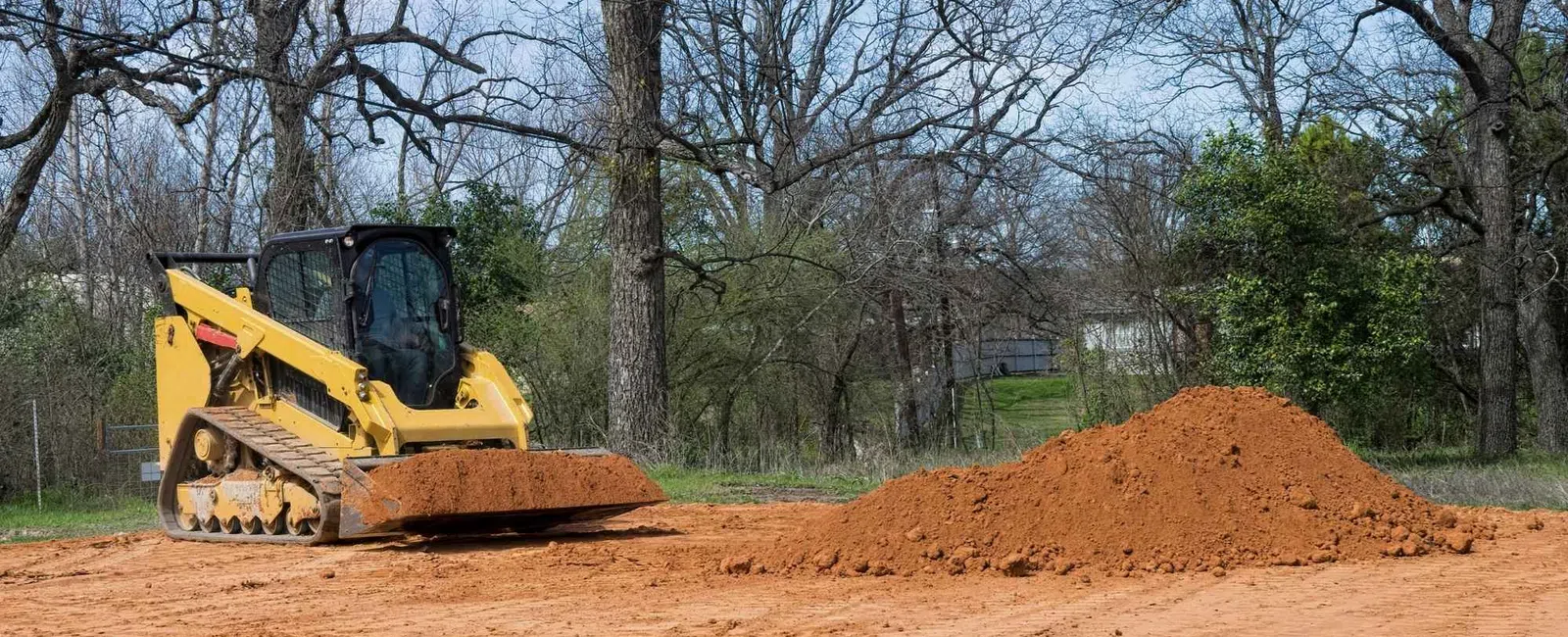
Most rubber tracks fail from how the machine is operated, not from accumulated hours. Two identical loaders on the same crew can be a full season apart on track life depending on surface and turning habits. The wear points below are what decide whether a track has service left in it.
What Actually Determines Track Life
Surface abrasion is the largest factor. Concrete, asphalt, and crushed stone grind rubber away several times faster than dirt or turf, and a machine that spends its day on a paved staging area will burn through tracks a graded site would not touch. Travel speed compounds it, because a loader driven at full speed across a hard yard generates heat in the track that a slower pass does not.
How the machine turns does the next most damage. Counter-rotation, meaning spinning in place with the tracks running in opposite directions, scrubs the outer lugs and puts shear load into the carcass. Working across a slope does something similar in one direction, loading one edge continuously until that side wears visibly ahead of the other.
Georgia sites add a specific problem. Red clay packs into the undercarriage when it is wet, then sets around the rollers and sprocket. A packed undercarriage effectively over-tensions the track from the inside and accelerates wear on every component it touches. Washing out the undercarriage at the end of a wet day is the cheapest thing an operator can do for track life, and it is the step most often skipped on a Friday afternoon.
The Wear Points That Decide Replacement
A track is finished when any one of these is true, not when all of them are:
- Drive lug height worn to roughly half of original, where traction drops off sharply and the machine starts slipping on grade
- Steel cord visible anywhere through the tread or the inner surface, which means the carcass is compromised and the track can separate without warning
- Inner drive lugs cracked, chipped, or missing, since these engage the sprocket and their failure is what causes a machine to throw a track
- Cuts through the tread deep enough to reach the cord layer, usually from rebar, curbs, or buried debris
- Cracking between the lugs running deep rather than surface weather checking
Exposed cord is the one that ends the conversation. A track showing steel is not a track to run another week, because separation under load can damage the undercarriage and put the machine down far longer than a planned replacement would.
The rest involve judgment. A track at half lug height with clean cord and sound inner lugs still has work in it on soft ground, but it will slip on a wet slope and it will not push a full bucket up a grade. Where the machine works decides whether that matters. A grading crew feels lost traction immediately. A machine that mostly carries material on level ground can finish the season.
Cracking is the one wear point that appears without hours. Rubber exposed to sun and ozone checks at the surface while a machine sits, so a loader parked through a slow season can come back looking worse than the hour meter suggests. Shallow checking across the face is cosmetic. Cracks running deep between the lugs are structural and put the track on a short clock.
Tension Is The Most Common Cause Of Early Failure
Track tension is set by an adjuster that pushes the front idler forward, and both directions of error are expensive. A track run too tight loads the sprocket, idlers, and rollers continuously, drawing more power and wearing the undercarriage along with the track. Owners often over-tension after a detracking incident, which trades one failure for a slower and more expensive one.
A track run too loose lets the drive lugs climb the sprocket and detrack, and detracking usually damages the lugs on the way out. It also lets debris work between the track and the idler, which is where most cut carcasses start.
Correct sag differs by machine and is published in the operator manual, so it is worth checking against the actual specification rather than by feel. Tension should be checked with the undercarriage clean, because packed material gives a false reading and leads operators to loosen a track that was correct to begin with.
Tread Patterns And Where Each One Belongs
Pattern choice changes track life as much as brand does, because a pattern used outside its intended surface wears fast and performs poorly at the same time.
- Multi-bar and staggered block patterns are the general-purpose option, giving reasonable traction on dirt and reasonable wear on hard surfaces, which suits machines that see mixed work
- Zig-zag and C-patterns clear mud well and grip soft ground, and they wear quickly and ride rough if the machine spends most of its time on pavement
- Turf and smooth patterns minimize ground disturbance for landscaping and finished-surface work, and they give up traction on grade and in loose material
Compound follows the same logic. A harder compound lasts longer on abrasive surfaces and grips less on soft ground, and a softer compound does the reverse. Specifying by the worst surface the machine touches regularly, rather than by where it spends the most time, is the more reliable method.
Check The Undercarriage Before Fitting New Tracks
New tracks on a worn undercarriage will not last. Sprocket teeth that have worn to a hooked profile no longer mesh cleanly with the drive lugs, and they will chew a new track considerably faster than the old one wore. The same applies to rollers with flat spots and idlers with worn flanges. Front idlers wear earliest on machines running heavy attachments such as mulching heads or large grapples, which carry more weight forward than the loader was balanced for.
There is also a wear relationship worth knowing. Undercarriage components and tracks wear each other, so a machine that has run one set of tracks well past their limit has almost certainly transferred some of that wear into the sprocket. Fitting new tracks to that machine without addressing the sprocket puts the new set on a shortened clock immediately.
Inspecting the sprocket, idlers, and rollers at the same time as the tracks tells you whether you are buying track life or throwing a new track at a problem further down the machine. It is a short inspection and it changes the recommendation often enough to be worth doing every time.
How To Read A Rubber Track Size
Track sizes are given as three numbers, and having them ready shortens the quoting conversation considerably. A size written as 320x86x52 means a track 320mm wide, with an 86mm pitch, running 52 links.
Width is measured across the outside face of the track. Pitch is the distance between the centers of two adjacent drive lugs on the inside surface, measured lug center to lug center rather than across the gap. Link count is the total number of drive lugs around the full loop, counted once around.
The size is usually molded into the inner surface of the track, though it wears off on older sets, which is when measuring becomes necessary. Machine make and model gets to the same answer in most cases, so having the model number is enough if the track is too worn to read.
Replacing Tracks Without Hauling The Machine
A track failure usually happens on site, which is the worst place for a machine that has to be trailered somewhere to get fixed. Loading a loader that has thrown a track is slow work, and the round trip plus a shop queue can turn a same-day job into several days off the schedule.
We replace rubber tracks for skid steers and compact track loaders on-site, at the yard or the job site where the machine works, so it goes back to grading and hauling on the same visit. Our Pressmen carry the tools for the job, and worn tracks leave with us and are disposed of under Georgia EPD standards.
If you run more than one tracked machine, a fleet assessment is the better starting point. We look at each unit, the surfaces it works, and the wear already on it, then recommend the pattern and compound per machine rather than fitting whatever the last set was.
Call 770.446.6467 or request an estimate, and tell us the machine and where it is sitting.